TMS Therapy is a non-invasive treatment for depression that uses magnetic fields to stimulate nerve cells in the brain. This therapy is particularly useful for patients who have not responded to traditional treatments such as medication or psychotherapy. The process is relatively quick, with each session lasting as little as 5 minutes, and patients can resume normal activities immediately afterwards.

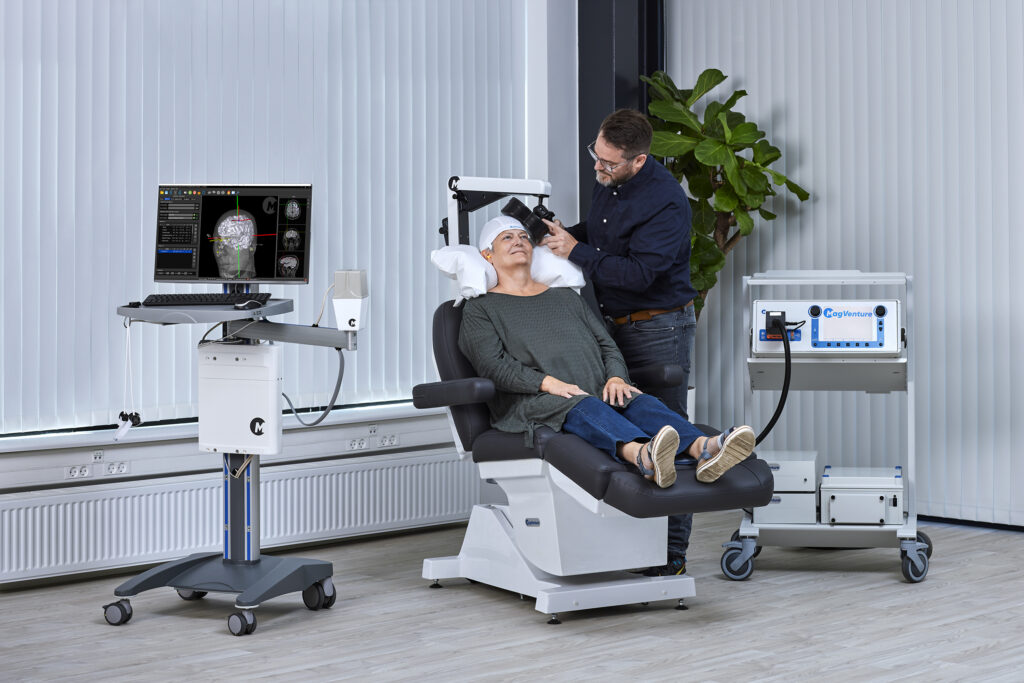
Transcranial Magnetic Stimulation (TMS) has been around for many decades and was only available at academic institutions for research and severe clinical cases. But ever since the FDA cleared and approved TMS for use in the general public for the treatment of depression and other conditions back in 2008, there has been a rapidly growing interest to use TMS Therapy as a reliable adjunctive or replacement treatment for depression and other conditions.
We invite you to come and discover the transformative potential of Transcranial Magnetic Stimulation (TMS) in enhancing brain health and well-being at our two Arizona Brain Health Centers – Gilbert and Scottsdale. TMS, a cutting-edge non-invasive procedure, offers a remarkable avenue for those seeking to optimize their mental wellness. By harnessing magnetic fields to stimulate specific regions of the brain, TMS has shown promising results in alleviating depression, anxiety, and various neurological conditions. Its remarkable ability to activate neural circuits and promote neuroplasticity paves the way for a brighter future in mental healthcare. Join us in exploring the boundless possibilities of TMS therapy for depression and other mental health conditions. Delve deeper into this revolutionary treatment that is reshaping the landscape of brain health. Your journey to a healthier mind starts here—let’s uncover the exciting realm of TMS together!
Your brain is composed of approximately 100 billion neurons. These neurons interact with each other through brain waves, or tiny electrical oscillations, to control how your brain functions.
These disruptions can be minor or significant. Everyone has different levels of tolerance. Some people still function in day-to-day activities, while others are to some degree debilitated and lose their quality of life.
TMS attempts to reprogram these abnormal electrical signals in the brain. By identifying where your brain waves are not properly communicating, we can help to restore optimal function. TMS technology can reshape the activity in your brain.
This cutting-edge treatment produces gentle magnetic waves stimulating the brain at personalized frequencies targeting.
Through TMS, we stimulate the exact area of your brain where communication is poor and increase activity in that area. This can help the brain learn pathways that have never been used or abandoned, or blocked by trauma.
TMS is non-surgical, non-invasive, painless, and completely drug-free. You are comfortable throughout the procedure. In most cases, we can visibly reshape brainwave activity, regardless of what may have caused the disruption.
Combined Transcranial Magnetic Stimulation (TMS) and Ketamine Infusion Therapy represents one of the most advanced treatment strategies in modern interventional psychiatry for patients with treatment-resistant depression (TRD), PTSD, bipolar depression, and severe mood disorders.
By pairing the neuroplastic effects of ketamine with the targeted neuromodulation of TMS, this integrated approach addresses both biochemical and circuit-level dysfunction, leading to faster, deeper, and more durable clinical outcomes.
At Lighthouse Psychiatry in Arizona, our protocol is physician-led, evidence-informed, and personalized to each patient’s neuropsychiatric profile.
Individually, both therapies are effective. Together, they offer synergistic benefits that exceed either treatment alone.
Combined Advantages:
This dual-modality approach is increasingly recognized as a next-generation standard for severe or complex depression.
Combined therapy is clinically applied for:
Neuropsychiatric assessment, prior treatment review, and safety screening.
Protocols may include:
Non-invasive, FDA-cleared stimulation targeting depression-related cortical circuits.
IV ketamine administered in a monitored medical setting to rapidly reduce depressive symptoms and enhance plasticity.
Outcome tracking, relapse prevention, and long-term planning.
This advanced protocol is typically recommended for patients who:
At Lighthouse Psychiatry, combined TMS and ketamine therapy is delivered with:
Both therapies are widely studied and considered safe when administered by trained specialists.
FAQ
Is it safe to combine TMS and ketamine?
Yes. When medically supervised, this combination is considered safe and increasingly used for refractory depression.
Which works first: TMS or ketamine?
Protocols vary. Some patients receive ketamine first to reduce symptoms rapidly, followed by TMS for stabilization.
Does insurance cover combined treatment?
TMS is often covered by insurance. Ketamine infusion coverage varies. Our team assists with preauthorization and payment options.
How long do results last?
Many patients experience sustained improvement when TMS stabilization is paired with ketamine maintenance.
Is this better than TMS alone?
For severe or refractory cases, combined therapy often produces more robust and durable outcomes.