When antidepressants just aren’t cutting it, a new generation of brain-based treatments is changing everything.
Let’s be real for a second — if you’ve been living with depression for years, tried medication after medication, sat through countless therapy sessions, and still wake up every day feeling like you’re underwater, you’re not broken. You’re not beyond help. You might just have what clinicians call refractory depression — and the good news is, in 2025, there are more powerful tools than ever to address it.
Here in Arizona, a quiet revolution in mental health care is happening. Advanced interventional psychiatry is moving beyond the prescription pad and into the realm of neuroscience — rewiring the brain at its source. Whether you’ve heard of TMS, ketamine, or Spravato and wondered if any of it could work for you, this guide is for you.
What Is Refractory Depression, Exactly?
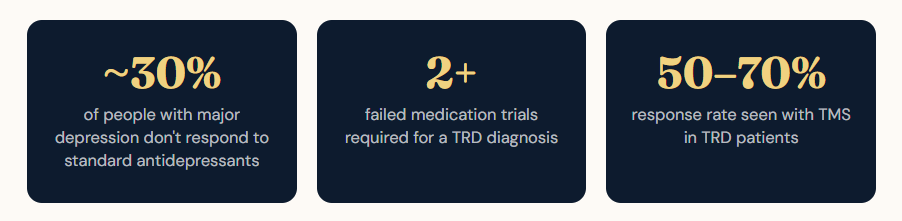
Refractory depression — more formally called treatment-resistant depression (TRD) — is generally defined as major depressive disorder that hasn’t responded to at least two different antidepressant medications taken at the right dose for an adequate period of time (typically 6–8 weeks each). It’s not a rare edge case. Studies suggest that roughly 30% of people with major depression don’t achieve remission with standard treatments.
The experience of refractory depression goes beyond the usual sadness. People describe it as a persistent numbness, an inability to feel joy, crushing fatigue, and a sense that nothing will ever work. It often coexists with anxiety, chronic pain, and disrupted sleep, making quality of life severely diminished.
“It’s not that these patients haven’t tried hard enough. It’s that their brain’s chemistry and circuitry require a different kind of intervention — one that works deeper than a pill can reach.”
Why Standard Treatments Fall Short
Most first-line treatments for depression — SSRIs, SNRIs, therapy, lifestyle changes — work wonderfully for a lot of people. But depression is not one disease. It’s a spectrum of neurobiological states, and the same approach won’t work for everyone.
For patients with TRD, the underlying problem often involves disruptions in specific neural circuits — particularly those connecting the prefrontal cortex, the limbic system, and the default mode network. These are not problems you can easily fix by simply boosting serotonin. That’s where interventional psychiatry comes in.
Additionally, genetic factors play a big role. Pharmacogenetic testing — a service offered by Lighthouse Psychiatry — can reveal why certain medications have failed you. Some people are rapid metabolizers of certain antidepressants; others carry genetic variants that affect how specific drugs work in the brain. Knowing this upfront is a game-changer in treatment planning.
What Is Interventional Psychiatry?
Interventional psychiatry is a sub-specialty focused on brain-based, non-oral treatments that directly target the neural circuits involved in mood, cognition, and behavior. Think of it as the cardiology of mental health — instead of just managing symptoms with medication, you’re directly addressing the underlying hardware.
The field includes treatments like transcranial magnetic stimulation (TMS), esketamine (Spravato), IV ketamine, electroconvulsive therapy (ECT), and newer innovations like photobiomodulation. These treatments have something important in common: they work through mechanisms that are fundamentally different from oral antidepressants, which is precisely why they can succeed where those medications have failed.
🔬 Key Principles of Interventional Psychiatry
- Neuroplasticity-based: Many of these treatments promote brain plasticity — the brain’s ability to form new connections
- Circuit-targeted: They act on specific neural circuits rather than general neurotransmitter levels
- Rapid-onset potential: Several interventions (especially ketamine/Spravato) can work within hours or days
- Complementary: Best results come from combining interventions with therapy and medication management
TMS Therapy: The Non-Invasive Brain Reset
Transcranial Magnetic Stimulation (TMS) uses precisely targeted magnetic pulses to stimulate underactive regions of the brain associated with depression — primarily the left dorsolateral prefrontal cortex. It’s non-invasive, FDA-cleared, and doesn’t require anesthesia. You sit in a chair, a coil is placed near your head, and you feel a tapping sensation. Most people read, listen to music, or scroll their phones during treatment.
At Lighthouse Psychiatry in Arizona, two advanced TMS options are offered:
Advance Rapid TMS
Standard TMS protocols can take 4–6 weeks of daily sessions. Rapid TMS protocols — like those using theta burst stimulation (TBS) — can condense treatment into accelerated schedules, sometimes producing results much faster. This is particularly valuable for patients in acute depressive episodes.
EEG-Guided TMS (MeRT)
MeRT stands for Magnetic EEG/ECG-guided Resonance Therapy. Instead of applying the same magnetic frequency to every patient, MeRT uses an EEG to map your brain’s unique electrical activity, then customizes the TMS protocol specifically to your brainwave patterns. Think of standard TMS as a one-size-fits-all approach — and MeRT as a completely personalized one. This level of precision is particularly valuable for complex, refractory cases.
Spravato (Esketamine): Fast-Acting Relief
Spravato is an FDA-approved nasal spray containing esketamine — a form of ketamine — specifically indicated for treatment-resistant depression and major depressive disorder with acute suicidal ideation. It’s administered in a certified clinical setting, meaning you come to the office, self-administer the spray under supervision, and rest for about two hours before heading home.
What makes Spravato remarkable is its speed. Traditional antidepressants can take 4–8 weeks to show effect. Spravato can produce meaningful symptom reduction within hours to days for many patients. It works through a completely different mechanism — blocking NMDA receptors and triggering a surge in glutamate, which in turn activates synaptic plasticity pathways. In plain terms, it helps the brain rewire and heal rapidly.
For patients with severe, refractory depression — especially those with passive suicidal thinking — the fast-acting nature of Spravato can be literally life-saving. Lighthouse Psychiatry’s Scottsdale and Gilbert locations are certified Spravato treatment centers, and their team closely monitors each patient’s response throughout the process.
Ketamine Infusions: An Old Drug, New Purpose
Ketamine has been used safely as an anesthetic since the 1970s. Over the past two decades, researchers discovered something remarkable: sub-anesthetic doses of ketamine produce rapid, powerful antidepressant effects — even in people who have failed multiple other treatments.
IV ketamine infusions work through the same glutamate/NMDA pathway as Spravato but deliver the medication intravenously, allowing for precise dosing. For many patients, a series of 6 infusions over 2–3 weeks can produce sustained remission — sometimes the first real relief they’ve felt in years.
Lighthouse Psychiatry also offers Ketamine-Assisted Psychotherapy (KAP) — a powerful combination where the ketamine infusion is paired with structured therapy sessions. During the neuroplastic window opened by ketamine, the brain is uniquely receptive to psychological healing. Patients often report breakthrough insights, reduced avoidance, and lasting changes in perspective that extend well beyond the infusion itself.
Photobiomodulation: Light Therapy for the Brain
Photobiomodulation (PBM) is one of the newer and more fascinating tools in the interventional psychiatry toolkit. It uses specific wavelengths of near-infrared light delivered to the scalp to penetrate into brain tissue and stimulate cellular energy production (specifically, cytochrome c oxidase in the mitochondria). The result? Enhanced neuronal function, reduced inflammation, and improved connectivity in key brain regions.
While PBM is perhaps less well-known than TMS or ketamine, emerging research is promising for conditions including depression, TBI, PTSD, and cognitive dysfunction. Lighthouse Psychiatry offers photobiomodulation as part of its comprehensive brain health approach — often as a complement to other interventional treatments.
The Power of Combining Treatments
Here’s something the research consistently shows: for refractory depression, combination approaches outperform single-modality treatment almost every time. The brain is complex, and the most effective treatment plans are usually layered ones — addressing neurochemistry, neural circuitry, psychological patterns, and lifestyle factors simultaneously.
A patient at Lighthouse Psychiatry might, for example, receive a course of MeRT-TMS while also undergoing Spravato sessions, supported by individual therapy, and complemented by medication management — all guided by the same team. This kind of integrated, coordinated care is what separates a true brain health center from a standard psychiatric practice.
💡 Sample Integrated Treatment Plan for TRD
- Pharmacogenetic testing to identify the right medication match
- Spravato or ketamine for rapid symptom stabilization
- TMS or MeRT-TMS for sustained circuit-level healing
- Individual therapy or EMDR to process underlying trauma
- Medication management to optimize any adjunct pharmacotherapy
- Photobiomodulation as a supportive brain health modality
Who Is a Good Candidate for Interventional Psychiatry?
You might be a good candidate for these advanced treatments if:
You’ve tried two or more antidepressants at adequate doses without achieving meaningful relief. You’ve noticed that medications give you only partial improvement, or you experience intolerable side effects that prevent effective dosing. You have a diagnosis of major depression that has been present for a year or more, significantly impacting your work, relationships, and daily functioning. You’re dealing with comorbid PTSD or anxiety that hasn’t responded to standard care. Or you’re a caregiver, veteran, healthcare worker, or someone with high occupational stress whose depression has a distinct neurobiological pattern.
It’s also worth noting that these treatments are not just for the most severe cases. If you’re someone who has managed to “get by” but has never truly felt well — what clinicians call chronic low-grade depression or dysthymia with recurrent major episodes — interventional psychiatry can be transformative.
How Lighthouse Psychiatry Can Help
Located in Gilbert and Scottsdale, Arizona, Lighthouse Psychiatry is one of the most comprehensive brain health centers in the state. Their mission is rooted in a simple but powerful idea: when someone is struggling with mental health, they deserve more than just a prescription and a follow-up in six weeks. They deserve a team, a plan, and access to the most advanced tools available.
The Lighthouse team includes board-certified psychiatrists, psychiatric nurse practitioners, licensed therapists, and clinical specialists — all working together under one roof. This integrated model means your TMS provider knows what your therapist is working on, and your medication manager understands the ketamine protocol you’re going through. Coordination isn’t an afterthought; it’s the entire point.
TMS & MeRT Therapy
FDA-cleared, non-invasive brain stimulation with both standard and EEG-personalized protocols for optimal precision. Learn about TMS →
Spravato (Esketamine)
FDA-approved nasal spray for treatment-resistant depression, administered in-office with clinical monitoring. Learn about Spravato →
Ketamine Treatment
IV ketamine infusions and ketamine-assisted psychotherapy for rapid, deep relief from refractory depression. Learn about Ketamine →
Photobiomodulation
Near-infrared light therapy targeting brain mitochondria for neuronal repair and anti-inflammatory effects. Learn about PBM →
Clinical Trials
Access to cutting-edge research studies for treatment-resistant depression and anxiety disorders. Explore Trials →
Counseling & Trauma Therapy
EMDR, ART therapy, CMI therapy, and ketamine-assisted psychotherapy for comprehensive healing. Explore Counseling →
Lighthouse Psychiatry also participates in clinical trials for treatment-resistant depression, giving qualifying patients access to the most cutting-edge interventions before they become widely available. Insurance is accepted, and the team works hard to make care accessible.
The bottom line? If you’ve been stuck in a cycle of “try this medication, wait six weeks, it’s not working, try another” — it’s time to ask a different question. Not “what antidepressant haven’t I tried yet?” but rather, “what kind of brain-based care might actually get to the root of what’s happening in my nervous system?”
Refractory depression is hard. But it is not hopeless. And you don’t have to navigate it alone.
Ready to Explore a New Path Forward?
If standard treatments haven’t given you the relief you deserve, Lighthouse Psychiatry’s team in Arizona is ready to build a personalized interventional plan around you — not the other way around.
📍 Location 1: Gilbert, Arizona
📍 Location 2: Scottsdale, Arizona
📞 Call Us (480) 565-6440
Book a New Patient Appointment
Questions? Email TMS@LHPSYCH.COM · Mon–Fri, 8 AM – 7 PM
Medical Disclaimer: This article is for informational purposes only and does not constitute medical advice, diagnosis, or treatment. Always consult a qualified healthcare provider about your specific condition. If you are experiencing a mental health emergency, please call 911 or the 988 Suicide & Crisis Lifeline by dialing or texting 988.